CacheBack
Agents can share internal model states conditioned on a request from the receiving agent.
Multi-agent systems let us parallelize computation and split large contexts across agents. These agents usually communicate through text messages, which take time to generate and can leave out evidence the receiving agent needs.
Work such as Cache-to-Cache, LatentMAS, and KVComm explores communication through internal model representations. We focus on a setting where agents read large, separate contexts and one receiver combines their findings. In this fan-in setting, methods that retain every sender position bring those contexts back together at the receiver, undoing the benefit of splitting them across agents. In our Qwen3-8B FanOutQA setup, full-cache transfer leaves insufficient context for receiver generation on every task.
Our idea is simple: what an agent sends should depend on what the receiving agent needs –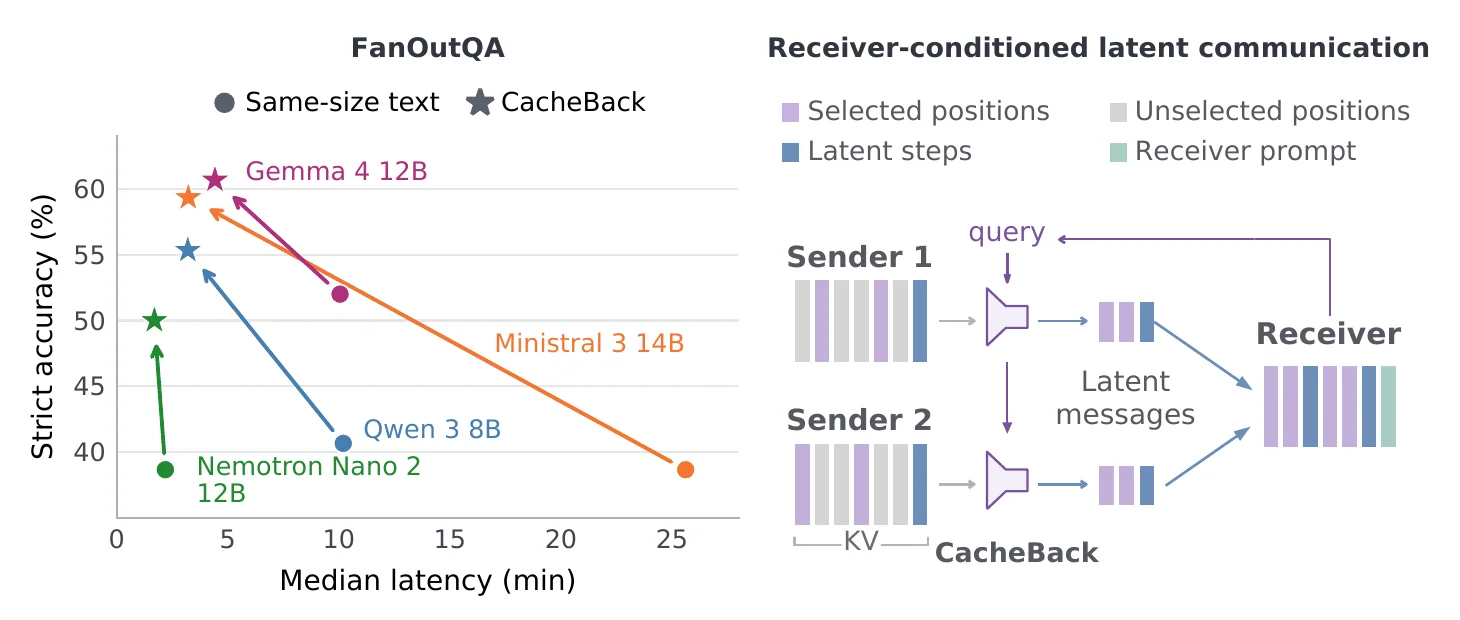 we call this receiver-conditioned communication. The sender uses a query from the receiver to select which parts of its internal state to share.
CacheBack is our simple, training-free implementation. It uses attention to the receiver’s request to select from the state the sender has already computed.
On FanOutQA, our selected operating points improve strict accuracy by 7.3–20.7 percentage points, with 1.3–8.0× faster median task completion than same-size text agents. We see improvements across four model families, including dense Transformers, Mamba-attention hybrids, and sliding-window attention. We also see gains when agents work in sequence on LongBench v2 Easy.
At 16× compression, CacheBack removes approximately 94% of sender positions while improving accuracy and latency over same-size text across every tested family and topology. This is a separate setting from the Qwen3-8B result in the TL;DR, which uses 4× compression.
Contributors
Max Rossi, Prajwal Raghunath, Haoqing Xuan, Yusen Zhang, Eugene Wu